Distrosub: Ethical Streaming on the Artists’ Side
Interview ★ Kenzie Gay ★ @kenzwrites ★ 4 Minutes
For several years now, conversations about the age of music streaming and its questionable ethics have been circulating. The big dogs like Spotify and Apple Music have been notorious for taking most of the revenue an artist makes from listens, causing a demand for fair wages and a desire for the return of physical media.
That brings us to Distrosub: the Australian-based streaming platform that prides itself on fairness, connection, and bringing morals back to the music business. I recently sat down with Lincoln, the founder, to bring some light to the company and its mission.
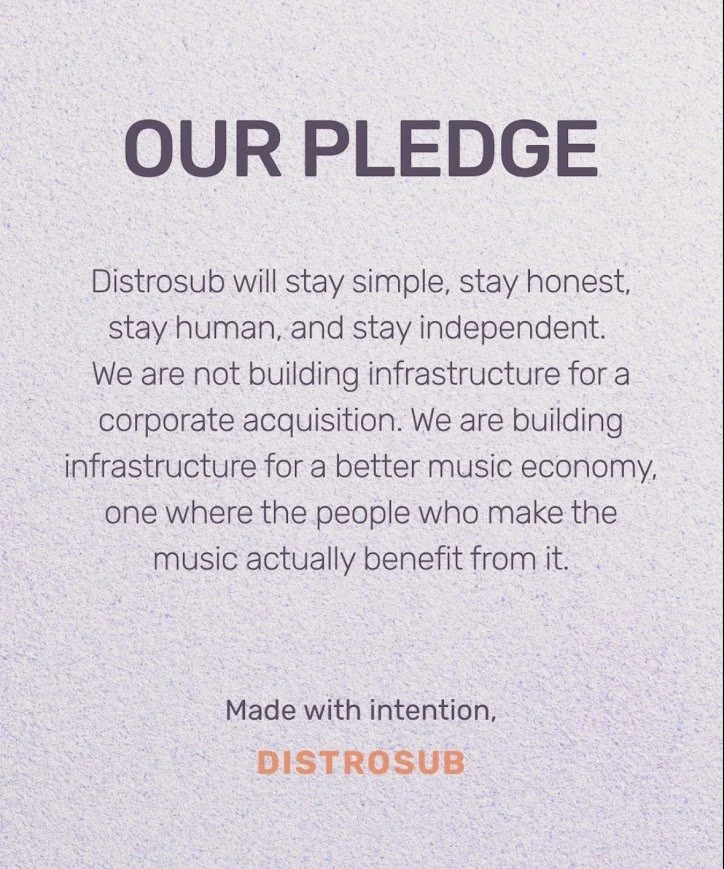
Distrosub’s pledge via InstagramWhat exactly makes Distrosub an ethical platform?
We position artists at the center of the platform, and everything else follows from that. Distrosub is built to give artists a direct connection with their audience, and to give fans a clear, direct way to support them. There's no mystery about where the money goes: a fan chooses an artist, and their support lands with that artist.
What was the goal or motivation of creating and building Distrosub?
I've worked with musicians for over a decade as a festival director and venue owner, so I've seen the challenges artists face up close: talented people with real audiences who still can't make a sustainable living from their music. The motivation has always been to find pathways to a living wage for artists. Live music can only carry so much of that load, and recorded music stopped paying most independent artists long ago, so we set out to build a practical way back.
Apart from its ethical standpoints, what else sets Distrosub apart from its big-name competitors such as Spotify and Apple Music?
Generally speaking, the major DSPs are extremely large multinational corporations that ultimately exist to benefit their shareholders, not the artists. That isn't a swipe at the people who work inside them, it's simply what those structures are built to do. Distrosub firmly positions artists as the most important stakeholders in the platform, and every decision we make starts from there. Being small, independent and close to our community also means artists talk directly to the people building the platform, and what they tell us shapes what we build next.
What was the biggest challenge you faced when turning this into a legitimate business?
Building something from the ground up. It takes so much time, energy, money, commitment and patience just to reach this point, and most of that work is invisible: payments, legals, infrastructure, all the unglamorous plumbing that has to be right before you can say the platform pays artists properly. We still have a huge amount to navigate, but we truly believe in our mission, and that's what keeps it moving.
Since launching, what has surprised you the most?
How overly complicated and opaque the music industry is. There's been a significant learning curve in navigating the global music system, particularly the financial mechanics of how money actually moves from a listener to an artist. The deeper you go, the more it feels skewed in favor of big business rather than the artists the whole thing depends on. It's only confirmed why something simpler and more transparent needs to exist.
How does the platform's payment model differ from standard streaming services?
Revenue on the major platforms is divided through a complex pooled system, which makes it difficult for artists to receive fair pay for their work, or even to track where the money is going. The significant difference with Distrosub is that rather than subscribing to the platform, listeners subscribe directly to each artist, and they choose the amount that artist receives, from as little as 10 cents a month up. Artists keep 80% of every subscription. It's simple, it's transparent, and it results in significantly more revenue reaching the artist per listener.
What do you think is currently wrong with the way major streaming platforms compensate musicians?
The royalty pool system works in the platforms' favour rather than the artists'. A listener's subscription is divided by global market share rather than by who they actually listened to, and what trickles out per stream is tiny. Just as importantly, artists have no access to their fans. The platforms hold that relationship, and we believe a direct connection with your audience is one of the most valuable things an artist can have in building a career.
Where do you see the company five years from now?
Hopefully at a scale where Distrosub provides a significant alternative income for artists, both here and internationally. There's plenty we want to build along the way, like native revenue splits so collaborators on a track are paid their share automatically, but mostly we'll be guided by the artists on the platform. And whichever way it goes, I'm sure we'll learn a huge amount that we can contribute to supporting artists along the way.
How do you make sure that independent and emerging artists are treated fairly?
Every artist on the platform has agency and control: over their music, over how they connect with their audience, and over how Distrosub works for them. The terms are the same for everyone, there's no exclusivity, and artists keep ownership of their work, so they can make informed decisions with nothing buried in fine print. Fairness isn't a policy we apply on top, it's how the platform is built.
If you could change ONE thing about the global music streaming industry, what would it be and why?
A living wage for musicians! Everything else follows from that one change. If the industry's starting point became that the people making the music should be able to live from it, then the payment models, the transparency and the artist-fan relationship would all have to be rebuilt to serve it. That's the single thing we'd change, and it's the reason Distrosub exists.